
The government also appointed Dr Vinod Paul, a pediatrician at the AIIMS, as a member of the NITI Aayog

Bajaj Finserv, Infosys, Mahindra & Mahindra, Tech Mahindra, Hindustan Unilever, State Bank of India and HCL Technologies were the biggest gainers. On the contrary, Asian Paints, JSW Steel, NTPC and Adani Ports were among the laggards.

Nestle, State Bank of India, Power Grid, Tata Steel, Larsen & Toubro and Mahindra & Mahindra were the other major gainers. In contrast, Tech Mahindra, Axis Bank and Reliance Industries were the laggards.

Stock markets will be largely driven by global trends in the absence of any major domestic triggers this week, say analysts. The trading activity of foreign investors, global crude oil prices and rupee-dollar movement will also influence market movement, they said. "Anticipating a period of consolidation in the absence of clear global cues, the market's trajectory will likely hinge on the movement of the US bond yields, the dollar index, and crude oil prices, as well as institutional flows.

Once we break free of the idea that land is scarce, real estate is just a pile of bricks, steel, and glass. Any price surge will kick off a supply response, which kills off the possibility of sustained price appreciation, points out Ajay Shah.

From the Sensex basket, Titan, Reliance Industries, Asian Paints, Tech Mahindra, IndusInd Bank, UltraTech Cement, Wipro and ITC were the major laggards. ICICI Bank, Infosys, Bajaj Finserv, Tata Steel, Axis Bank, Bajaj Finance, Nestle and Mahindra & Mahindra were among the major gainers.
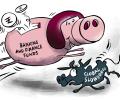
Companies in the banking, finance sector and insurance (BFSI) sector have underperformed on the bourses despite leading the earnings growth charts in the post-pandemic period. This has created a dichotomy between their earnings and share prices. BFSI companies have never been less expensive than the rest of the equity market.

Titan Company, Axis Bank, NTPC, Tata Motors, ITC, Tech Mahindra, Bajaj Finserv, ICICI Bank, HDFC Bank and Bajaj Finance were the other laggards. Bharti Airtel, Power Grid, Infosys and Larsen & Toubro were among the gainers.
IT and interest rate-sensitive bank, realty, and auto stocks ended with sharp gains.
Benchmark equity indices Sensex and Nifty rebounded on Wednesday, propelled by bargain hunting in index majors Reliance Industries, ITC and SBI amid a largely firm trend in global equities. In a highly volatile trade, the 30-share BSE Sensex rebounded 89.64 points or 0.12 per cent to settle at 72,101.69. During the day, it jumped 390.62 points or 0.54 per cent to 72,402.67.

Among major Sensex movers, ITC rose the most by 1.70 per cent, Wipro by 1.43 per cent, Tech Mahindra by 1.36 per cent and Nestle India by 1.27 per cent. Other gainers included HCL Tech, Asian Paints and Reliance. On the other hand, ICICI Bank, NTPC, UltraTech Cement and Tata Steel traded with a loss of up to 0.82 per cent.
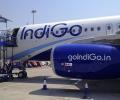
IndiGo share price today: IndiGo share price fell as much as 4.8 per cent to a low of Rs 4,275 per share on the BSE in Monday's intraday trade as investors booked profit in the stock post a its April-June quarter (Q1) results for financial year 2024-25 (FY25). The stock ended 1.36 per cent lower at Rs 4,430 as against a 23-points gain in the benchmark BSE Sensex. The selling also got exacerbated as the management commentary, post Q1FY25 results, highlighted that inflationary pressure could likely dent July-September (Q2FY25) performance.

Indian equity markets have a limited upside potential in the near-term as they negotiate the ensuing cyclical slowdown, wrote analysts at Nomura in a recent coauthored report led by Saion Mukherjee, their managing director and head of equity research for India. He, however, believes that the foundations are in place for sustainable growth over the medium-to-long term, and hence suggests a 'buy on dips' strategy to equity investors. As an investment strategy, Nomura prefers domestic-oriented sectors and companies over exporters, and prefers stocks that provide valuation comfort. Industrials and banks are their overweight sectors, while IT services and consumer discretionary are their underweight sectors.

Applicants for Indian citizenship under the Citizenship (Amendment) Act 2019 (CAA) can submit any of nine documents, including valid or expired passport, ID cards and land tenancy records, to prove he or she is a national of Afghanistan or Bangladesh or Pakistan.

From the Sensex basket, Sun Pharma, Maruti, Power Grid, Titan, JSW Steel, Tech Mahindra, Larsen & Toubro and State Bank of India were the major laggards. Tata Motors, Tata Consultancy Services and Nestle were the gainers.
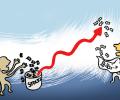
'The good news is that money continues to flow into India-focussed offshore funds.'
The ongoing second quarter earnings, movement of oil benchmark Brent crude and the uncertainty in the Middle East would dictate terms in the domestic markets this week, analysts said. Furthermore, the activities of Foreign Institutional Investors (FIIs) will also influence trading in the markets. "A slew of earnings reports from heavyweights expected this week will significantly impact market direction.

The inflow of cheap capital has also kept the rupee at a high level, making exports uncompetitive and broadening the current account deficit despite falling oil prices.

Ajay Banga was on Wednesday appointed the next president of the World Bank, becoming the first-ever Indian-American to head the global financial institution which said it looks forward to working with him at a time when it's tackling the toughest development challenges facing developing countries. "The executive directors of the World Bank today selected Ajay Banga as president of the World Bank for a five-year term beginning June 2, 2023," the bank said in a press statement. In February, President Joe Biden announced that the US would be nominating Banga, 63, to lead the World Bank because he is "well equipped" to lead the global institution at "this critical moment in history."

Finance Minister P Chidambaram on Friday launched trading in currency futures at the National Stock Exchange in Mumbai.
Postings to places at an altitude above 1,000 metres but less than 1,500 metres, between 1,500 and 3,000 metres, and above 3,000 metres entail different rates of allowances -- the higher the location, the bigger the allowance, reveals Tamal Bandyopadhyay.
Titan was the top gainer in the Sensex pack, rising 3.5 per cent, followed by Kotak Bank, SBI, Maruti Suzuki, Bajaj Finance, HUL, Axis Bank and Sun Pharma. On the other hand, NTPC, Tech Mahindra, PowerGrid and Infosys were the laggards.

Macroeconomic data announcements, global trends and trading activity of foreign investors would guide momentum in the equity market this week, analysts said. Markets ended a five-week losing streak and gained nearly a per cent last week, helped by a sharp rebound on Friday. Last week, the BSE benchmark jumped 500.65 points or 0.77 per cent and the Nifty gained 169.5 points or 0.87 per cent.

As Prime Minister Narendra Modi begins his first ever US visit, India made a pitch for listing by American and other foreign companies on Indian exchanges under the newly proposed Bharat Depository Receipts.

Bibek Debroy raised seven questions about the new institution.

Last October's circular meant that downstream investment by such funds by way of subscription or acquisition of shares would have been considered "indirect foreign investment" if their investment manager or sponsor is owned or controlled by a non-resident. The finance ministry has now said that mutual funds that invest more than 50 per cent in equity shall be omitted from the Securities and Exchange Board of India (Mutual Funds) Regulations, 1996.

'We have to keep a watch because India-Sri Lanka has a history that whenever there has been a change in government, either the connectivity projects have been questioned or cancelled or revived.'

Benchmark equity indices ended marginally higher on Thursday, trimming most of their intra-day gains, as investors turned cautious ahead of the quarterly results of IT behemoths TCS and Infosys later in the day. Announcement of the US inflation data and domestic macroeconomic numbers also forced investors to remain on the sidelines. The 30-share BSE Sensex climbed 63.47 points or 0.09 per cent to settle at 71,721.18.

'If you see another 1000-point correction, people may start panicking.'

Equity markets this week will be largely guided by trends in global stocks, foreign funds' trading activity and progress of monsoon, analysts said. Investors will also track the movement of rupee against the US dollar and crude oil prices. Benchmark indices Sensex and Nifty closed at fresh lifetime highs on Friday.

Portfolio investors based out of the US and other countries with which India does not have favourable tax treaties will have to pay a 15 per cent tax on their derivative transactions, after the Budget decided to classify income from all foreign portfolio investment as capital gains.

Before considering reducing the freedom of private investors in the derivatives market, we need to check if the maladies in markets elsewhere exist in India, says Susan Thomas.

Trading in the equity market this week will be highly influenced by a host of important triggers, with quarterly earnings from IT majors TCS, Wipro, and domestic inflation and IIP data taking the centre stage in dictating the movement in equities, analysts said. Besides, global factors and trading activity of foreign investors will also drive markets. "We are approaching the first quarter earnings season, with HCL Tech, TCS and Wipro set to report their earnings this week.
After a positive opening, the 30-share BSE Sensex suddenly faced selling pressure in late-afternoon trade. It finally settled just 5.67 points, or 0.01 per cent, lower at 39,586.41.

Among the Sensex firms, Adani Enterprises and Adani Ports sustained their gaining momentum and traded higher by 4.40 per cent and 4.37 per cent, respectively. BPCL, Axis Bank, Mahindra & Mahindra and SBI were the other major gainers. On the other hand, HCL Tech, Infosys and Bajaj Auto traded in the negative zone with a loss of up to 1.54 per cent.
Rising outgo towards clearing and settlement fees has led to an altercation between the BSE and the National Stock Exchange of India (NSE), with the latter striking down the former's request to lower the charges. NSE said it has no plans to restructure the same and that it will continue with the pricing defined under the interoperability framework. The interoperability framework, introduced in 2019, allows trades executed on any of the exchanges to be settled or cleared at either of the two clearing corporations -- NSE Clearing (NCL) or Indian Clearing Corporation (ICCL), fully-owned by the NSE and the BSE, respectively.

Among the Sensex firms, Infosys, Tech Mahindra, HCL Technologies, Tata Consultancy Services, Wipro and JSW Steel were the major gainers during the morning deals. Nestle, Bharti Airtel, Axis Bank ITC were among the laggards.

Among the Sensex firms, Larsen & Toubro, Bharti Airtel, HCL Tech, Tata Motors, Sun Pharma and Tata Steel were the major gainers. On the other hand, Nestle, Asian Paints, Bajaj Finserv, HDFC Bank and Axis Bank were among the laggards.

Wipro was the biggest loser among Sensex firms, sliding 2.32 per cent, followed by HDFC Bank, Power Grid, UltraTech Cement, ITC, ICICI Bank and Tata Motors. IndusInd Bank, Maruti, State Bank of India, Mahindra & Mahindra, Asian Paints and Bajaj Finserv were among the gainers.

The Securities and Exchange Board of India (Sebi) has proposed that at least 10 per cent of corporate bond market trades by foreign portfolio investors (FPIs) should be done on the request for quote (RFQ) platform. At present, most trades in the corporate bond market are over-the-counter (OTC), creating a lot of opacity. The markets regulator has been nudging debt market participants such as mutual funds (MFs), alternative investment funds (AIFs) and brokers to use the RFQ platform to boost secondary market liquidity and transparency.
